
Generative AI and Journalism in the Southern Mediterranean
A summary report of the webinar held on 30 April 2026, exploring generative AI's implications for journalism in the Southern Mediterranean through the lenses of field practice, academia, ethics, and critical theory.

Webinar Summary Report · 30 April 2026
This report summarises a webinar held on 30 April 2026 on generative AI and its implications for journalism in the Southern Mediterranean region.
The session brought together four speakers—Saja Murtada (AFCN Manager, Led by ARIJ), Ahmed Esmat (Lecturer, AUC, Media Tech and Digital Transformation Consultant), Anass Ben Drif (Senior Media and Disinformation Expert), and Jairo Lugo-Ocando (Dean of College of Communication, University of Sharjah)—each offering a distinct perspective: from field practice and AI tool deployment, to academic training, ethical governance, and critical theory.
Discussions covered AI adoption strategies, fact-checking innovation, newsroom ethics, journalism education, and the structural challenges unique to non-Western media environments. A recurring theme was the tension between the promise of AI as a productivity tool and the risk of over-relying on technology to solve problems that are fundamentally political, economic, and cultural.
This document summarises the key talking points from each speaker, the issues shared across all interventions, and the collective recommendations that emerged from the discussion.
Event Recording
Watch the full recording of the webinar on YouTube.
Speaker Talking Points
1. Saja Murtada — AFCN Manager, Led by ARIJ
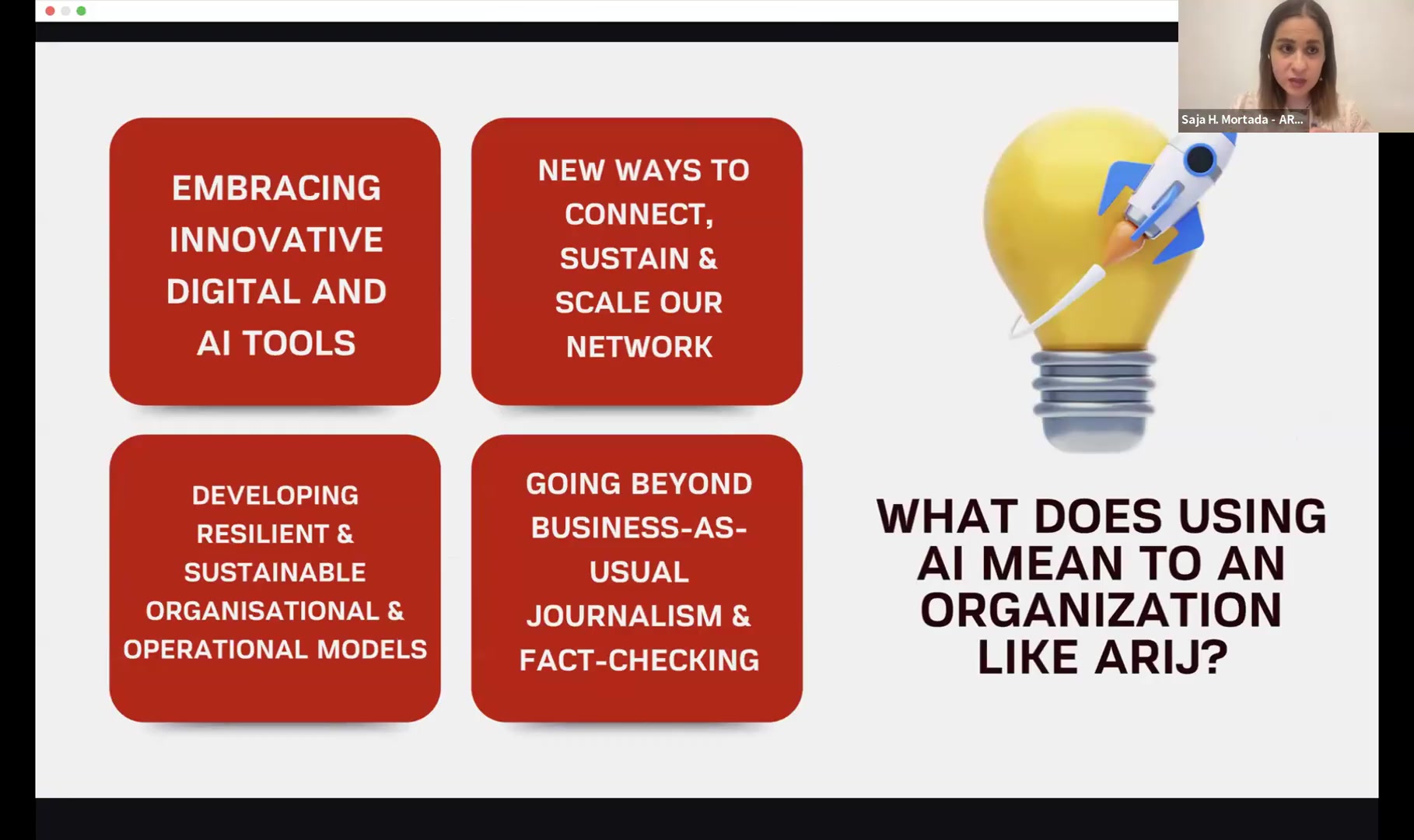
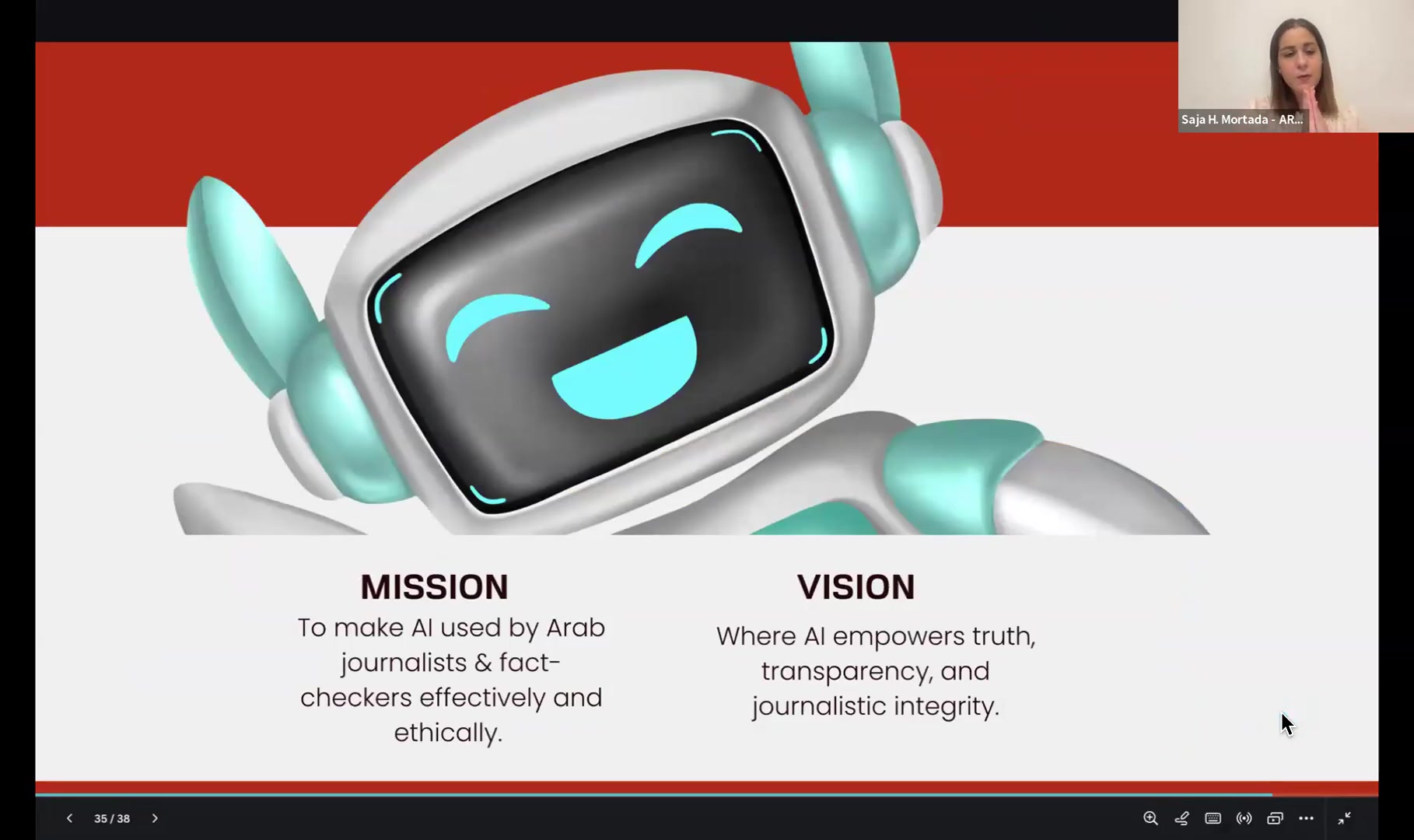
- AI Journey: ARIJ has integrated AI since 2021, winning the Google Innovation Challenge in 2022 and developing a formal AI Strategy and Ethical Guide for responsible use across Arab newsrooms.
- AFCN Chatbot: An Arabic-language fact-checking chatbot launched in 2023 processes audience claims; approximately 10% are handled automatically by AI, the rest verified by fact-checkers across 10 Arab countries.
- Training: Over 3,000 journalists trained through the JournalismAI Discovery Course and in-person sessions in 12+ countries, including a Training of Trainers model for scalable regional impact.
- Collaboration: Key partnerships with Google, Full Fact, Deutsche Welle, and regional organisations; AI success depends on cross-disciplinary networks.
- Future Focus: Investigating AI-related harms and deepfakes; advancing truth, transparency, and ethical journalism in Arabic-language contexts.
2. Ahmed Esmat — Lecturer, AUC, Media Tech and Digital Transformation Consultant
- AI Journalism Diploma: Launched the region’s first accredited AI and Journalism Diploma at AUC, combining theory with hands-on newsroom applications.
- Readiness Assessment: Recommended evaluating both technical infrastructure and human capacity before any AI implementation, drawing on Microsoft’s readiness framework.
- Regional Examples: Highlighted An-Nahar (Lebanon) and Masr El Youm (Egypt) as successful MENA cases of AI integration in editorial workflows.
- Human-Centric Approach: Stressed that change management and people-first thinking are essential; AI adoption fails without newsroom buy-in and clear workflows.
3. Anass Ben Drif — Senior Media and Disinformation Expert
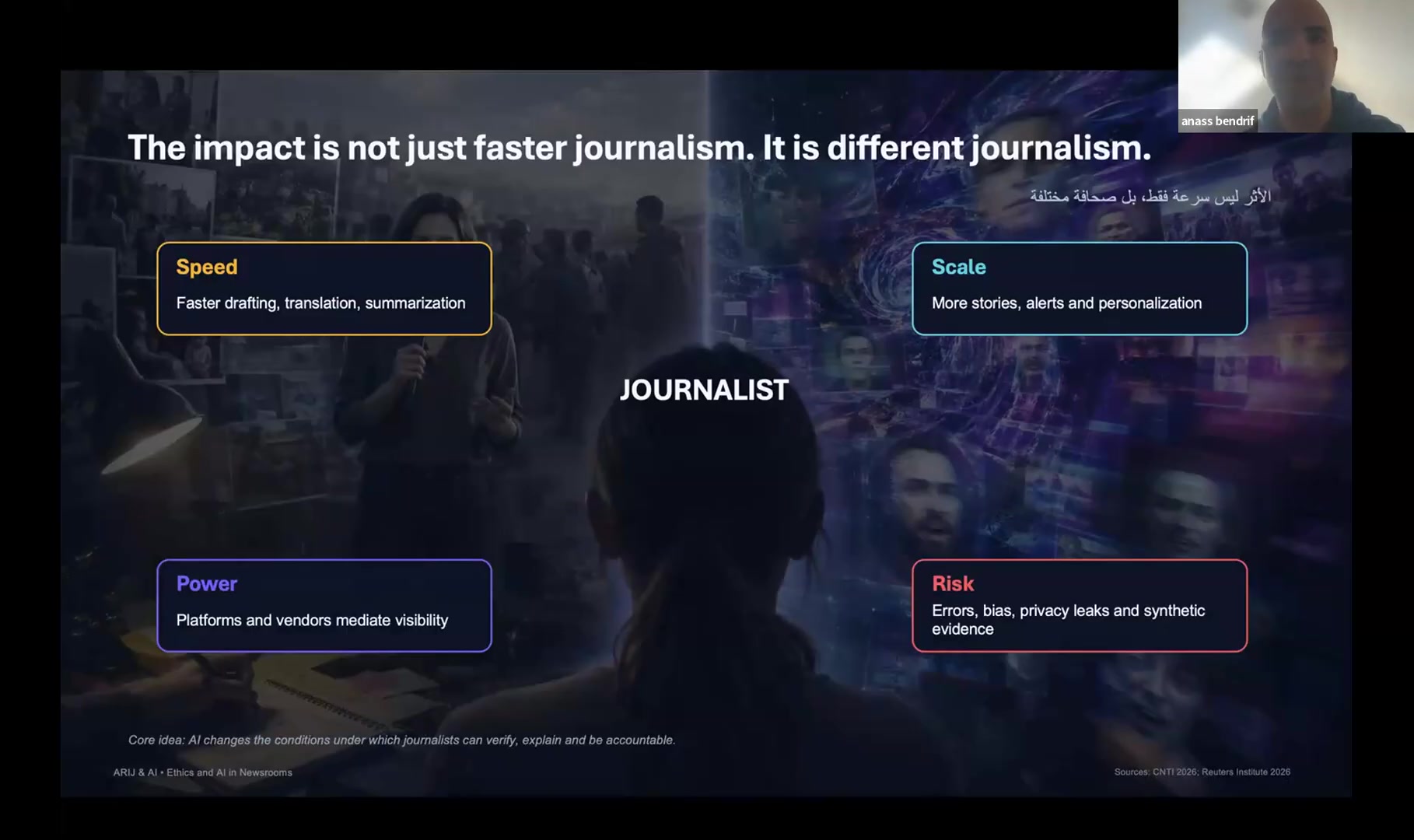
- Accountability First: Human responsibility must be preserved even when AI assists in production; journalists and editors must remain answerable for every published story.
- Ethical Checkpoints: Proposed embedding ethics reviews at each editorial stage: data gathering, verification, production, and distribution.
- Bias & Privacy Risks: Warned against algorithmic bias in AI-generated visuals and poor data handling practices that risk audience privacy.
- Core Message: The more automated journalism becomes, the more visible and deliberate human judgment must be.
4. Jairo Lugo-Ocando — Dean of College of Communication, University of Sharjah
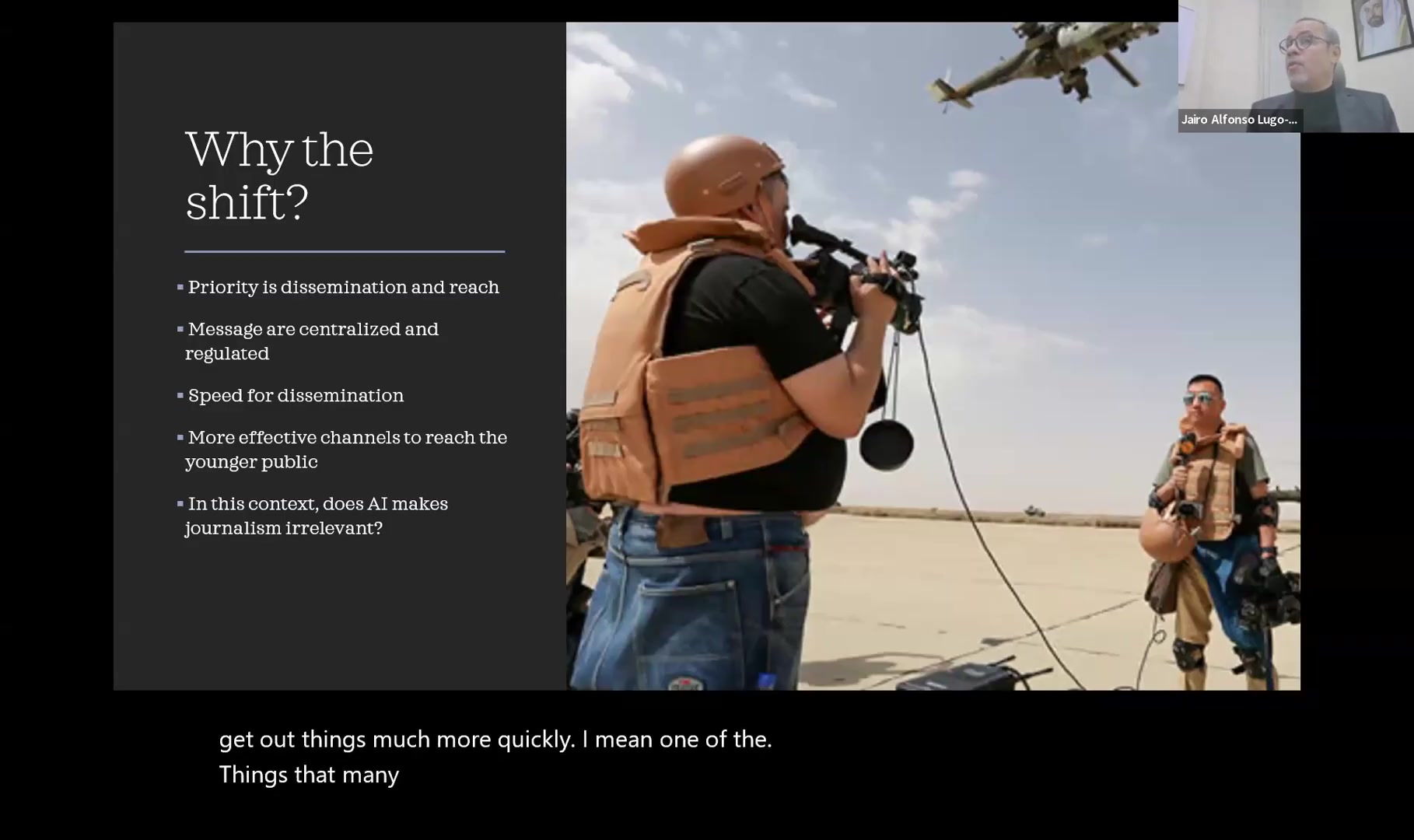
- Critical Perspective: Challenged the assumption that AI can solve journalism’s structural problems; censorship, lack of funding, and weak source access require political and social solutions, not technical ones.
- MENA-Specific Barriers: Identified state media control, overreliance on official sources, low media literacy, and declining reading habits as the real obstacles facing the region.
- Influencers vs. Journalists: Critiqued the rise of social media influencers in place of credentialed journalists for government communications, raising serious legitimacy concerns.
- Technology is Not Neutral: AI’s impact depends entirely on who deploys it and with what intent, especially in contexts involving migration, security, and human rights.
- Regional Identity: Called for a distinct Arab and Mediterranean journalism identity, rather than the uncritical adoption of Western models and tools.
Key Issues Shared Across All Speakers
- Ethical and responsible AI use—human judgment must stay central to every editorial decision.
- Need for sustained AI literacy and training programs tailored to Arab journalists.
- Structural bias in large language models and the lack of high-quality Arabic-language AI tools.
- Human-in-the-loop oversight as the foundation of trust and editorial accountability.
- Risk of techno-determinism—AI cannot fix political, economic, or structural media failures.
- Declining media literacy and reading habits among younger audiences across the region.
- Embedded Western ideologies in LLMs that may misrepresent non-Western realities and values.
Recommendations
- Establish sustained AI training programs covering both technical skills and editorial ethics.
- Develop clear newsroom AI governance policies, including bias checks, privacy safeguards, and transparency standards, before deployment.
- Build regional collaboration networks across academia, media organisations, civil society, and tech partners.
- Treat AI as an assistive tool—preserve human roles in interpretation, context, and editorial judgment.
- Promote critical thinking, reading culture, and media literacy alongside technical AI skills in journalism education.
Key Takeaways
- AI is a support tool, not a replacement for journalists or editorial judgment.
- Ethics, literacy, and collaboration are the pillars of responsible AI adoption in the region.
- The Southern Mediterranean requires localised strategies that reflect its language, governance, and resource realities.
- Visible human oversight is non-negotiable for credibility and public trust in AI-enhanced journalism.
- The fundamental challenges facing journalism in MENA—censorship, funding, audience engagement—will not be solved by AI alone.
The EuroMedAI network remains committed to amplifying regional voices in the intersection of AI and media, and to supporting journalism that serves the public interest across the Mediterranean.
مشاركة