
Submitted by: EuroMedAI (Euro-Mediterranean Network for AI Governance) For: First session of the United Nations Global Dialogue on AI Governance, 6 and 7 July 2026, Geneva Drafted: 29 April 2026 · Published: 10 May 2026
0. Introduction and Context
EuroMedAI is a cross-shore network of researchers, civil society organisations and technologists across the Euro-Mediterranean, launched at the Anna Lindh Foundation’s ALForum 2025 in Tirana. We work where the Northern, Southern and Eastern shores of one sea meet, a region that fits neither a purely Global North nor a purely Global South frame. The Dialogue’s mandate sits at the centre of our work. In our February 2026 statement on Resolution 79/325, we welcomed the Independent International Scientific Panel and called for the Global Dialogue to be an open, rights-grounded forum. Our central argument is simple: closing the AI divide is a precondition for legitimate global governance, not a footnote to it. The responses below draw on our own research and convenings, including our comparative assessment of AI capacity across nine South Mediterranean countries.
1. In your opinion, what outcomes would make the first Global Dialogue on AI Governance a success? (Max. 300 words)
A successful first Dialogue should deliver a shared diagnostic, a financing commitment and a follow-up architecture.
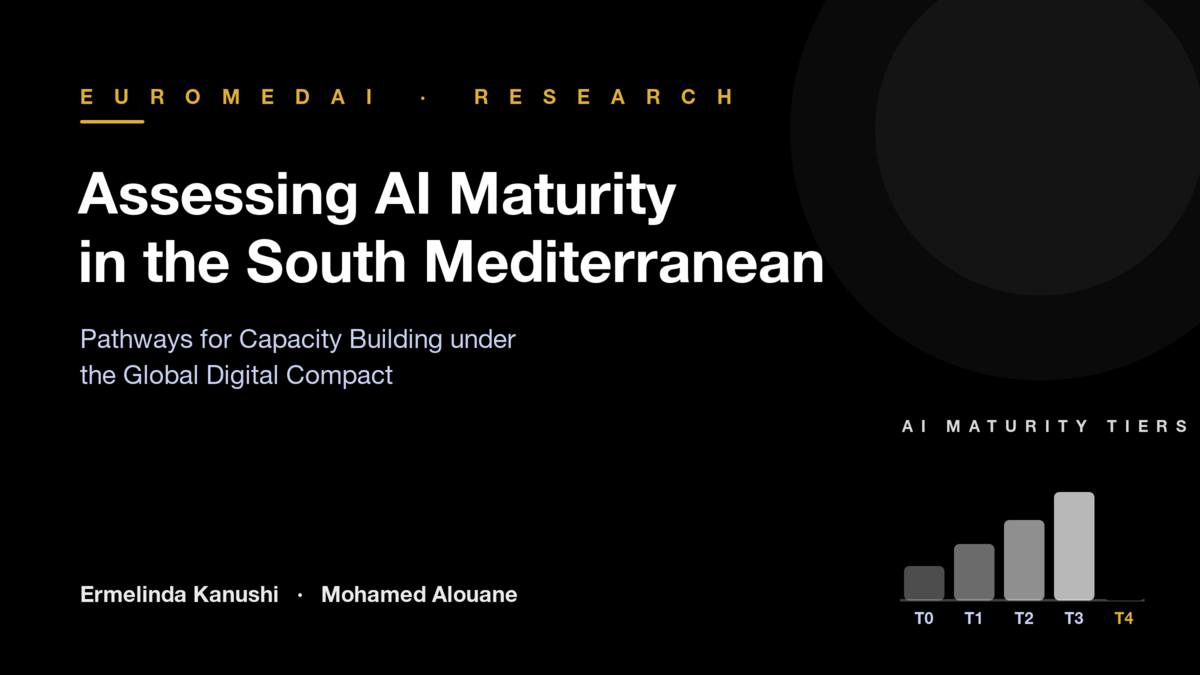
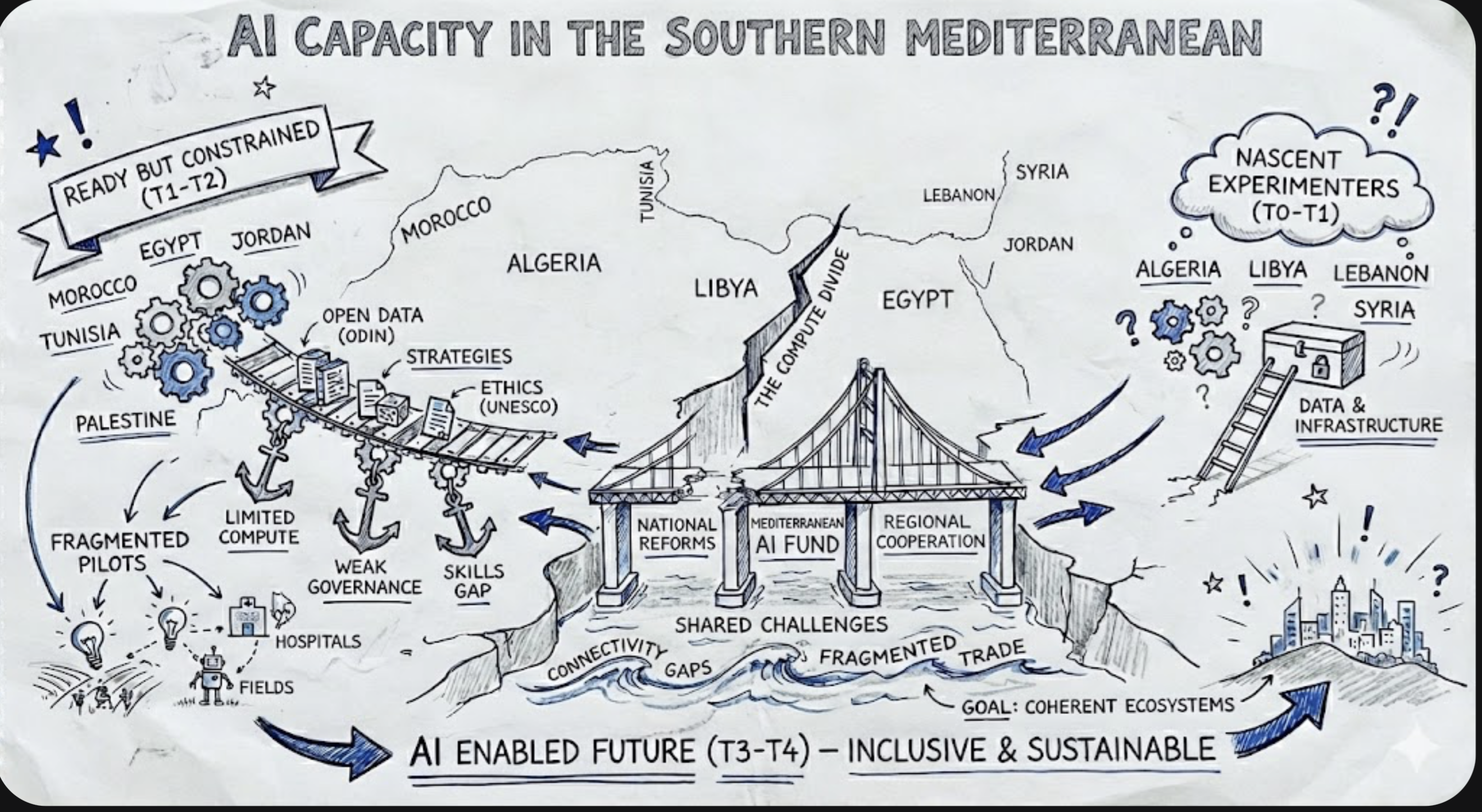
On the diagnostic: the Dialogue should adopt a common, evidence-based method for measuring where countries actually stand. In our October 2025 report, Bridging the AI Divide, we applied the UN Secretary-General’s Tier 0 to 4 maturity framework (A/79/966) to nine South Mediterranean states and found a two-speed trajectory: Morocco, Egypt and Jordan are “AI ready,” while the rest remain nascent or experimenting, constrained by limited sovereign compute, weak data governance and modest skilled workforces. A method like this lets governments report on capacity reality, not strategy documents alone.
On financing: success means moving from principle to floor. Building on A/79/966 and on our November 2025 dialogue “Financing Mediterranean AI Capacity,” the Dialogue should endorse the idea of a “Minimum Irreducible Capacity” every state needs, and concrete instruments to reach it, such as pooled regional funds and compute-credit matching. Capacity gaps are a governance failure, not only a development one.
On follow-up: the co-chair summary should commit to a public reporting cycle and to keeping participation open. As we argued in our Resolution 79/325 statement, the Dialogue must be “an open forum, not a closed-door briefing.” That means published procedures, civil-society engagement throughout, and a registry of commitments with status updates between the Geneva and New York sessions.
Above all, a successful Dialogue would treat the divide between AI builders and AI bystanders as the structural problem it is, and would commit states, industry and international organisations to measurable steps that narrow it within a fixed calendar.
2. Which thematic areas reflect your priorities? Please select up to 4 and briefly explain. (Max. 300 words)
Safe, secure and trustworthy AI; AI capacity-building; Social, economic, ethical, cultural, linguistic and technical implications of AI; Interoperability of governance approaches. Protection and promotion of human rights runs through all four as the floor beneath them.
AI capacity-building is our first priority because, across the Southern Mediterranean, governance ambitions outpace capacity. Our maturity assessment shows national strategies that remain underfunded, sectoral pilots that rarely scale, and acute brain drain. Without a capacity floor, the other themes are aspirational.
Social, economic, cultural and linguistic implications matter because current models are strongest in high-resource languages. Arabic and its dialects (Darija, Egyptian, Levantine), Tamazight, Kabyle and other Mediterranean low-resource languages are under-served, which shapes who AI works for. Our cross-border research agenda and our work on AI in journalism address this directly.
Interoperability of governance approaches is essential for a region whose economies are deeply interlinked yet whose rules diverge. At the second Mediterranean Forum on Artificial Intelligence (FMIA 2025) in Tunis, we contributed to shaping a long-term Mediterranean cooperation agenda for AI governance. Interoperability does not mean identical rules; it means shared methods and shared baselines so that innovators can scale across borders and citizens enjoy comparable protection.
Safe, secure and trustworthy AI is the umbrella. Trust is built in practice: our May 2026 digital-security masterclass for Moroccan territorial actors and our April 2026 webinar on generative AI in newsrooms show that safety must be operational, multilingual and reachable by local actors, not only specified at the frontier.
We select these four because they are the conditions under which AI in our region becomes inclusive and rights-respecting rather than a vector for deepening existing inequalities.
3. Are there cross-cutting or emerging issues not captured by the listed themes? (Max. 300 words)
Five issues deserve explicit attention.
Compute and language sovereignty. The seven themes treat compute and language as background. For our region they are decisive. Our research finds that even “AI ready” states rely on imported models and external clouds, with no domestic frontier development and persistent gaps in Arabic, Amazigh and dialect coverage. Governance written only at the application layer cannot reach decisions taken at the compute and model layer. The Dialogue should treat compute access and linguistic representation as governance objects.
Regional-bridge geographies. Global debate is often framed as North versus South. The Euro-Mediterranean is neither: one network, one sea, three shores, with European policy capacity alongside North African and MENA realities. Governance frameworks that recognise only two poles leave bridge regions without a seat that fits.
Information integrity in multilingual settings. Our April 2026 journalism webinar surfaced AI-enabled disinformation, deepfakes and the erosion of shared facts, compounded when fact-checking tools and training are scarce in Arabic and local languages. This cuts across safety, rights and accountability.
Environmental cost in water-stressed states. Data-centre energy and water demand land in Mediterranean economies already exposed to climate stress. The Dialogue should require measurement and disclosure of AI’s resource footprint.
Financing as governance. Where states cannot afford a minimum capacity, they cannot meaningfully comply with or shape any framework. Financing for compute, data and skills is therefore a governance instrument, not a charitable add-on. We developed this argument in our “Financing Mediterranean AI Capacity” dialogue within the Barcelona+30 process, aligned with A/79/966.
Naming these issues links high principle to the structural conditions that decide whether governance reaches the people it is meant to protect.
4. How are governance gaps in your selected areas affecting your region? Highlight key challenges and opportunities. (Max. 300 words)
The Southern Mediterranean faces a two-speed trajectory documented in our maturity assessment. A smaller group (Morocco, Egypt, Jordan) is “AI ready but constrained,” while a larger group (Algeria, Tunisia, Lebanon, Libya, Syria) and the distinctive case of Palestine remain nascent or experimenting. The binding constraints are consistent: limited sovereign compute, uneven data governance, and modest AI-skilled workforces.
These gaps produce concrete harms. First, dependency: even advanced states rely on imported foundation models and distant clouds, raising latency, cost and sovereignty risks. Second, misalignment: high-capability models serve high-resource languages well and Arabic, Darija, Tamazight and Levantine poorly, so public-sector deployment in citizens’ own languages remains weak. Third, fragmentation: as our work with the Union for the Mediterranean shows, shallow digital-trade provisions, connectivity gaps and limited cross-border data-sharing prevent regional AI ecosystems from scaling. Fourth, brain drain: as our financing dialogue underlined, talent leaves faster than it can be retained, and only a minority of pilots ever scale.
The opportunities are equally real. Several states have strong open-data foundations (Morocco, Palestine, Jordan and Tunisia score well on the Open Data Inventory). UNESCO Readiness Assessments and emerging ethical-AI charters give a normative starting point. National anchors such as Egypt’s BA-HPC and Morocco’s Toubkal supercomputer could seed shared regional infrastructure.
The decisive question is whether interventions are coordinated. Left to national effort alone, the divide widens and existing inequalities harden. With a regional floor (shared compute, common norms, cross-border research on Arabic and low-resource languages) the same assets could move the region from fragmented pilots toward coherent, rights-respecting and integrated AI ecosystems. The Dialogue can tilt the balance toward the second path.
5. What role can the AI Dialogue play in advancing international cooperation on AI governance? (Max. 300 words)
The Dialogue’s distinctive value is as a bridge-builder, and EuroMedAI’s experience speaks directly to that role.
First, it can bridge measurement. Bilateral and plurilateral processes cannot produce a method every government uses in common. The Dialogue can. We have shown, in “Bridging the AI Divide,” that the UN’s own maturity framework can be operationalised across very different national contexts to compare capacity honestly. Adopted widely, a shared method lets cooperation rest on evidence rather than assertion.
Second, it can bridge frameworks to realities. Global instruments exist (UNESCO’s Recommendation on the Ethics of AI and its Readiness Assessment Methodology, the OECD principles and capability indicators, A/79/966 on financing). Translating them into specific regional and linguistic contexts is where they succeed or fail. Our entire model, from FMIA 2025 in Tunis to our work with the Union for the Mediterranean, is about turning global norms into Mediterranean practice. The Anna Lindh Foundation’s motto that we carry forward, “From Dialogue to Action,” captures the gap the Dialogue must close.
Third, it can bridge shores and blocs. The great-power binary will not produce universal rules in the time available. The Dialogue offers legitimacy for middle-power and regional coordination, where bridge regions like the Euro-Mediterranean can move on shared baselines without waiting to be unblocked.
The Dialogue should not attempt a single global rulebook. Harmonising every rule is neither realistic nor desirable, because jurisdictions face different threats. What states need is a common method for measuring whether their rules work, a shared vocabulary for the divides their citizens face, and a calendar that holds everyone to follow-up. On that, universal participation makes the Dialogue uniquely credible.
6. What existing initiatives or mechanisms should the Dialogue build upon, and what added value could it bring? (Max. 300 words)
The Dialogue should connect rather than duplicate.
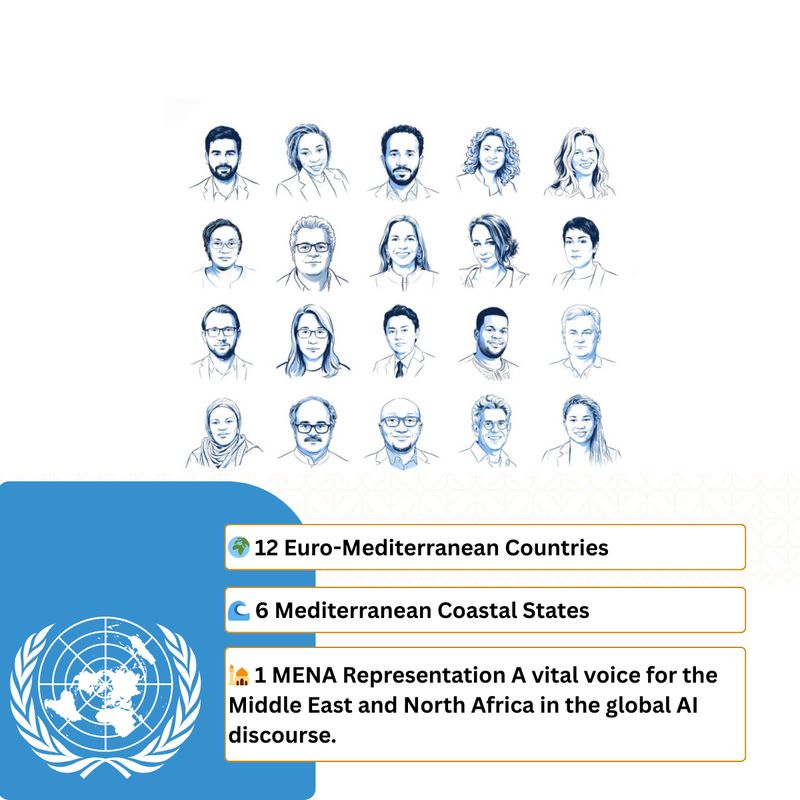
UN instruments. A/79/966 on innovative financing for AI capacity-building already offers the maturity framework and the financing logic our region needs; the Dialogue should anchor capacity discussions there. The Independent International Scientific Panel established under Resolution 79/325 should be commissioned to produce recurring, comparable capacity and divide assessments. We note that twelve of the Panel’s forty experts come from the Euro-Mediterranean, a presence the Dialogue should use.
Normative and methodological bases. UNESCO’s Recommendation on the Ethics of AI and its Readiness Assessment Methodology, adopted and applied across the region (including in Palestine, Morocco and Egypt), provide the rights baseline and a diagnostic tool. The OECD AI Capability Indicators help match model capabilities to language and sector needs. The Dialogue should tie reporting to these rather than invent parallel ones.
Regional architecture. The Union for the Mediterranean, where we presented our capacity report at the 7th Trade and Investment Forum and the 5th Digital Transformation Conference in Antalya, links digital trade, connectivity and integration. The Anna Lindh Foundation and the Mediterranean Forum on Artificial Intelligence (FMIA) convene the regional governance conversation. The Barcelona+30 process frames financing. ESCWA and the Arab League AI working groups carry normative weight in the Arab region.
Capacity and literacy. The AMSA-AI platform we supported, with DDI MENA, Innovation for Change MENA Hub and CIVICUS, shows how inclusive AI literacy reaches local governance actors.
EuroMedAI’s added value is a standing regional evidence base and observatory: a comparable, multilingual, country-level picture of capacity that the Dialogue can plug into directly, so that global cooperation is informed by what is actually happening on each shore.
7. How can different stakeholders contribute? Recommendations for format and structure. (Max. 300 words)
The Dialogue should be multistakeholder and multilingual by design, not as an afterthought.
Member states bring sovereignty and reporting duties. We recommend annual national capacity reports built on a shared maturity method, so that contributions are comparable across borders. States should also be encouraged to bring aggregated regional positions, since Mediterranean economies are interlinked and rules that diverge raise compliance costs for innovators.
Civil society and research organisations bring methodology and evidence. EuroMedAI’s comparative assessment is one example of what an independent network can supply: an operational, country-level dataset. The Dialogue should give civil society a permanent track with rapporteur standing across the themes, and appoint a civil-society liaison supporting the co-chairs before, during and after each session, as several peer submissions also urge.
Industry brings deployment data and infrastructure no government holds. Frontier and cloud providers active in the region should be asked to report capability and access data, and to participate in compute-credit and in-kind contribution mechanisms rather than only voluntary pledges.
Youth and women are core to our mandate, not a quota. Our network embeds youth, women and underrepresented communities by design, and the Dialogue’s structure should do the same through dedicated places in working tracks.
On structure, three rules: working tracks split by theme, each producing one deliverable per cycle; a permanent secretariat with technical and multilingual capacity rather than a rotating chair alone; and a public follow-up dashboard tracking commitments against outcomes between sessions.
The single most useful structural change is to tie the Dialogue’s calendar to a public reporting cycle. That turns it from a forum where things are said into an accountability mechanism where progress is recorded.
8. Which voices or perspectives are currently underrepresented, and how could they be included? (Max. 300 words)
Three constituencies are underrepresented, and our region embodies all three.
The Southern and Eastern Mediterranean as a bridge. Global discussion underrepresents regions that are neither frontier developers nor purely recipient economies. Our work exists precisely to amplify these regional voices in global AI debate. Inclusion requires more than invitations: it needs regional pre-Dialogue consultations resourced from the UN budget, travel and translation support, and agenda-setting power so positions enter Geneva and New York on equal footing.
Speakers of Arabic and low-resource languages. People who think and work in Modern Standard Arabic, Darija, Egyptian and Levantine Arabic, Tamazight and Kabyle are under-served by models and largely absent from governance rooms. The Dialogue should make multilingual materials and interpretation standard, and should commission cross-border research on these languages, an agenda we already pursue. Linguistic exclusion is governance exclusion.
Local territorial actors, youth and women. The populations the themes are about (citizens facing AI in public services, elected local officials, journalists, teachers) rarely have a seat. Our May 2026 digital-security masterclass for Moroccan local stakeholders and our support for the AMSA-AI literacy platform show how to reach them: practical, multilingual capacity-building delivered where they work, with women and youth deliberately included. The Dialogue should establish a community-witness track giving structured testimony from these actors, with a formal response from each working track.
Concrete inclusion measures should be non-negotiable: resourced participation, decentralised and hybrid convenings hosted on the Southern and Eastern shores as well as in Europe, multilingual access, and public tracking of whose input shaped outcomes. Without these, inclusion is symbolic. With them, it becomes the source of better governance.
9. What innovative engagement formats could most effectively foster meaningful engagement? (Max. 300 words)
Four formats, each producing a citable public artefact.
Live maturity and divide audits. The Dialogue should run, in plenary, a demonstration of the capacity-assessment method we built in “Bridging the AI Divide”: real indicators, real countries, the divide measured and discussed in the room. This turns an abstract debate about inequality into a shared, visible diagnostic that governments can then apply at home.
Regional pre-Dialogue consultations anchored on existing convenings. Rather than building new venues, the Dialogue should plug into the Union for the Mediterranean, the Anna Lindh Foundation and the Mediterranean Forum on Artificial Intelligence, and their equivalents in other regions. We have contributed to each of these, and they are ready-made channels for grounded, regional input that feeds the Geneva and New York sessions.
Multilingual deliberation between sessions. Structured online deliberation, run in Arabic, French, English and other regional languages, should surface where agreement actually exists across jurisdictions in the months between sessions, with results published and tabled in working tracks.
Community-witness sessions. Short, structured panels of teachers, journalists, doctors, local officials and trade unionists, on the public record, with a formal written response from each working track within a fixed window. Our journalism webinar and territorial masterclasses show the value of testimony from people who deploy and are affected by AI.
What unifies these is accountability. The Dialogue’s risk is becoming a place where much is said and little is recorded. The least flashy format is the most necessary: a public registry of every commitment made, with status updates published on a fixed cycle. Without it, even the best engagement produces no follow-through.
10. Please share examples of policies, practices or approaches that promote effective AI governance. (Max. 300 words)
We offer concrete approaches drawn from our work and our region.
A transferable maturity-tier methodology. Our report operationalised the UN Tier 0 to 4 framework using public indicators (the Government AI Readiness Index, the Open Data Inventory, OECD AI Capability Indicators, UNESCO’s Readiness Assessment Methodology). It turns capacity from anecdote into a comparable dataset across nine countries. Any region can apply the same method to benchmark itself and target investment.
Minimum Irreducible Capacity plus shared infrastructure. Rather than leave compute to chance, we proposed a defined floor of compute, data and skills every state needs, and a Shared South-Med Hub of roughly 800 A100-equivalent units anchored on existing assets such as Egypt’s BA-HPC and Morocco’s Toubkal supercomputer. Pooling lowers cost and reduces dependency on distant clouds.
A Mediterranean AI Fund and compute credits. Following A/79/966, we proposed pooled regional financing and a compute-credit matching platform to secure access for public-interest projects in nascent-tier countries. This is the financing-as-governance principle made operational.
Ethical-AI frameworks made concrete. UNESCO Readiness Assessments, already adopted in Palestine, Morocco and Egypt, should be paired with algorithmic impact assessments, risk-based classification, transparency requirements for high-risk uses, oversight bodies and accessible redress.
Inclusive AI literacy. The AMSA-AI platform we supported delivers practical, safe-use AI literacy to local governance actors in their own languages, an inclusion-by-design model.
Newsroom AI governance. From our journalism webinar: clear newsroom AI policies with bias checks, privacy safeguards and transparency standards, treating AI as an assistive tool while preserving human editorial judgment.
These are not aspirations. They are practices in motion across the Euro-Mediterranean that the Dialogue can study, adapt and scale.
EuroMedAI, Euro-Mediterranean Network for AI Governance. One sea, one collaborative platform for truly inclusive AI.
سجل التحديثات
Published submission ahead of the first UN Global Dialogue on AI Governance (Geneva, 6–7 July 2026)
الأحدثInitial drafting of the submission