
Ermelinda Kanushi¹ · Mohamed Alouane²
¹ AI Governance and Policy Researcher, University of Technology Nuremberg, Germany ² AI Policy Researcher, EuroMedAI
Abstract
South Mediterranean countries face widening disparities in artificial intelligence (AI) capacity across compute, data governance, skills, adoption, and enabling strategies. Building on the United Nations Global Digital Compact (GDC) and the UN Secretary-General’s report A/79/966 on innovative voluntary financing options for AI capacity-building, this chapter contextualizes regional readiness and proposes practical pathways to advance through AI maturity tiers. We synthesize evidence from international benchmarks (e.g., the Government AI Readiness Index 2024) and official policy documents, and we retain a comparative country table that classifies eight South Mediterranean states by AI maturity tier. We find that most countries cluster in lower tiers, with pockets of progress where national strategies, sector pilots, and compute initiatives exist. Recommended actions include (i) phased, rights-respecting national AI strategies; (ii) regional approaches to sovereign compute and data collaboration; (iii) scaling pilots into national programs; and (iv) leveraging voluntary and blended financing aligned with A/79/966 to unlock equitable AI benefits in line with sustainable development.
Keywords: Artificial intelligence, Global Digital Compact, capacity building, AI governance, South Mediterranean, AI readiness, sustainable development.
1. Introduction
The acceleration of artificial intelligence (AI) across the globe has created both opportunities and profound challenges for countries at different stages of technological development. While advanced economies have been able to invest heavily in compute infrastructure, data ecosystems, and skills pipelines, many developing and middle-income regions are still defining their entry points into the AI landscape. For the South Mediterranean, this reality poses a dual challenge: how to bridge structural gaps in readiness while ensuring that AI adoption remains consistent with principles of rights, equity, and sustainable development.
In 2024, UN Member States adopted the Global Digital Compact at the Summit of the Future, articulating a shared commitment to steer digital transformation, including AI, in ways that are inclusive, safe, and aligned with international cooperation (United Nations, 2024). Building on that mandate, the UN Secretary-General’s report A/79/966 (2025) introduced a structured approach to capacity-building through innovative voluntary financing. The report highlights two essential pillars: AI foundations such as compute, data governance, skills, adaptable models, connectivity and energy, and AI enablers such as national strategies, regulation, and cooperation. To operationalize these pillars, it proposes a five-tier maturity framework ranging from Tier 0 (nascent) to Tier 4 (developers). This chapter situates the South Mediterranean within that global conversation. The analysis draws on international benchmarks such as the Government AI Readiness Index 2024 (Oxford Insights, 2024), the OECD’s Artificial Intelligence Review of Egypt (2024), UNESCO’s AI readiness work for Morocco, Tunisia and Egypt, and the United Nations’ Economic and Social Commission for Western Asia (ESCWA) regional foresight work (2025), as well as national strategies and policy documents. The objective is to provide a comparative regional picture of AI maturity that highlights both achievements and persistent vulnerabilities.
The disparities in AI capacity across the South Mediterranean risk deepening existing inequalities in economic development, digital sovereignty, and access to innovation. At the same time, they create opportunities for regional cooperation: pooling resources, developing shared compute and data infrastructure, aligning governance frameworks, and mobilizing financing in line with the Global Digital Compact.
Against this backdrop, the chapter pursues three aims. First, it situates the South Mediterranean within the global AI readiness landscape. Second, it assesses the maturity levels of eight countries in the region using the tier framework derived from A/79/966, with a focus on foundational and enabling factors. Third, it proposes practical policy options for building equitable AI capacity through national reforms, regional cooperation, and innovative financing.
By framing the South Mediterranean’s trajectory in terms of both risks and opportunities, the chapter underscores that AI adoption in this region is more than a technical undertaking. It is a governance challenge, a developmental project, and a shared responsibility. The following sections review existing literature, present the methodology, and discuss the comparative findings that underpin the recommendations.
2. Literature Review
The literature on AI governance, adoption, and readiness underscores the persistence of global and regional disparities in capacity, infrastructure, and policy implementation. In the context of the South Mediterranean, existing research and international benchmarks reveal both emerging opportunities and systemic challenges. This section reviews global frameworks, regional strategies, sectoral applications, and structural barriers to AI readiness, drawing on authoritative academic and institutional sources.
Global AI Readiness and Governance
At the global level, the Government AI Readiness Index 2024 produced by Oxford Insights provides one of the most widely used benchmarks for assessing countries’ preparedness to adopt AI in governance and the public sector (Oxford Insights, 2024). The index evaluates 193 states along three dimensions—government capacity, technology sector strength, and data/infrastructure availability—and highlights a widening divide between high-income economies and developing regions. South Mediterranean countries typically rank in the lower-to-middle range, with Jordan and Egypt scoring higher than peers.
Complementary insights are provided by the OECD through its AI Policy Navigator and Artificial Intelligence Review of Egypt (OECD, 2024), which offers a detailed case study of AI policy implementation in a lower-middle-income country. The review emphasizes that while Egypt has made notable progress in strategy formulation and sectoral pilots, challenges remain in infrastructure, skills, and alignment with international ethical standards. More broadly, Jobin et al. (2019) map the global landscape of AI ethics guidelines across 84 documents in Nature Machine Intelligence, finding convergence around core principles alongside significant divergence in implementation—underscoring the fragmented character of global AI governance and the need for coordinated approaches that integrate human rights and sustainable development.
Regional AI Strategies and Governance
At the regional level, a growing body of scholarship and policy analysis explores the status of AI governance in the Middle East and North Africa (MENA). Trigui et al. (2024), writing in Data & Policy, provide one of the first systematic analyses of AI governance in the region. They argue that while several countries have adopted AI strategies, these documents often remain aspirational and face gaps in implementation, monitoring, and institutional capacity. Similarly, the Arab Reform Initiative (2024) reviewed the national AI strategies of multiple Arab states, identifying wide variation in ambition, sectoral focus, and regulatory depth. Some, such as the United Arab Emirates and Egypt, have developed comprehensive frameworks, whereas others lag behind with minimal policy guidance.
Fadi Salem’s State of AI and Data Governance in the Arab Region (2024), produced jointly by the ESCWA and the Mohammed Bin Rashid School of Government, highlights the uneven adoption of data governance frameworks, the lack of harmonization across countries, and the tendency for policy documents to outpace actual institutional readiness. These findings resonate with broader concerns about the gap between strategy and execution in AI governance.
Beyond strategies, sectoral studies shed light on adoption patterns and barriers. Al-Zahrani and Alasmari (2025), in Education and Information Technologies, provide a comparative study of AI adoption in higher education across 19 MENA countries. They find that while enthusiasm for AI in teaching and research is rising, universities face systemic barriers such as inadequate funding, limited infrastructure, and lack of faculty expertise. The authors argue that these deficits mirror national-level gaps in digital transformation.
International organizations also contribute valuable insights. UNESCO (2023), through its Strengthening AI Governance initiative, piloted a capacity-building framework in several developing countries, emphasizing problem definition, multi-stakeholder participation, and competency development for civil servants. ESCWA’s Artificial Intelligence Futures for the Arab Region (2025) projects opportunities and risks in deploying AI across sectors such as health, education, and public administration, stressing the importance of cultural and linguistic adaptation and rights-based governance.
Structural Barriers and Comparative Studies
The structural barriers that inhibit AI adoption are consistently identified in the literature. Ali and Khan (2024), in a systematic review published in Data Science and Management, synthesize evidence on factors influencing organizational AI readiness, identifying infrastructure, governance, human capital, top management support, and resource availability as the dominant determinants, and caution that neglecting any of these pillars undermines long-term progress.
Salem (2024) further emphasizes governance challenges in the Arab region, pointing to fragmented data protection frameworks and the absence of strong regulatory authorities. Tortoise Media’s Global AI Index (2024) also positions MENA countries behind global leaders, underscoring the persistence of disparities in R&D investment, compute infrastructure, and AI talent pools.
Identified Gaps in the Literature
Across these sources, several consistent gaps emerge. First, there is a pronounced implementation–strategy gap: many South Mediterranean countries have drafted AI strategies, but few have translated them into coordinated action or measurable outcomes (Trigui et al., 2024; Arab Reform Initiative, 2024). Second, sovereign compute capacity and energy reliability remain limited, with only a handful of facilities in Egypt and Morocco. Third, data governance and ethical safeguards are uneven, often lagging behind international norms (Salem, 2024). Fourth, the development of human capital remains constrained, compounded by the migration of skilled professionals (Al-Zahrani & Alasmari, 2025). Finally, regional cooperation on AI infrastructure and governance remains weak, despite frequent calls for shared approaches (ESCWA, 2025).
3. Tools and Methodology
This methodology of our study builds on the AI maturity tier framework proposed in the UN Secretary-General’s report A/79/966, which defines five levels of AI capacity: Tier 0 (nascent), Tier 1 (experimenters), Tier 2 (ready), Tier 3 (enabled), and Tier 4 (developers). Our assessment applied this model to eight South Mediterranean countries: Algeria, Egypt, Jordan, Lebanon, Libya, Morocco, Syria, and Tunisia. The methodology combines primary and secondary data sources. Primary signals include government plans, official national AI or digital strategies, laws and regulations, and facility-level disclosures such as the Bibliotheca Alexandrina High Performance Computing (HPC) facility in Egypt and Morocco’s TOUBKAL supercomputer. Secondary sources include international benchmarks such as the Government AI Readiness Index 2024 by Oxford Insights, UNESCO’s AI capacity-building work for Morocco, Tunisia and Egypt, the OECD Artificial Intelligence Review of Egypt (2024), and ESCWA policy reports on AI futures in the Arab region. The analysis focuses on five domains mapped from A/79/966: compute and infrastructure; data and governance; skills and institutions; models and adoption; and strategy and cooperation.
Countries were placed in tiers according to their present capabilities, not their potential or stated ambitions. This ensures a realistic baseline for comparative analysis and progression pathways. To validate placements, we cross-referenced multiple sources, including government announcements, UNESCO and UNIDO documentation, and academic studies.
4. Findings and Comparative Analysis
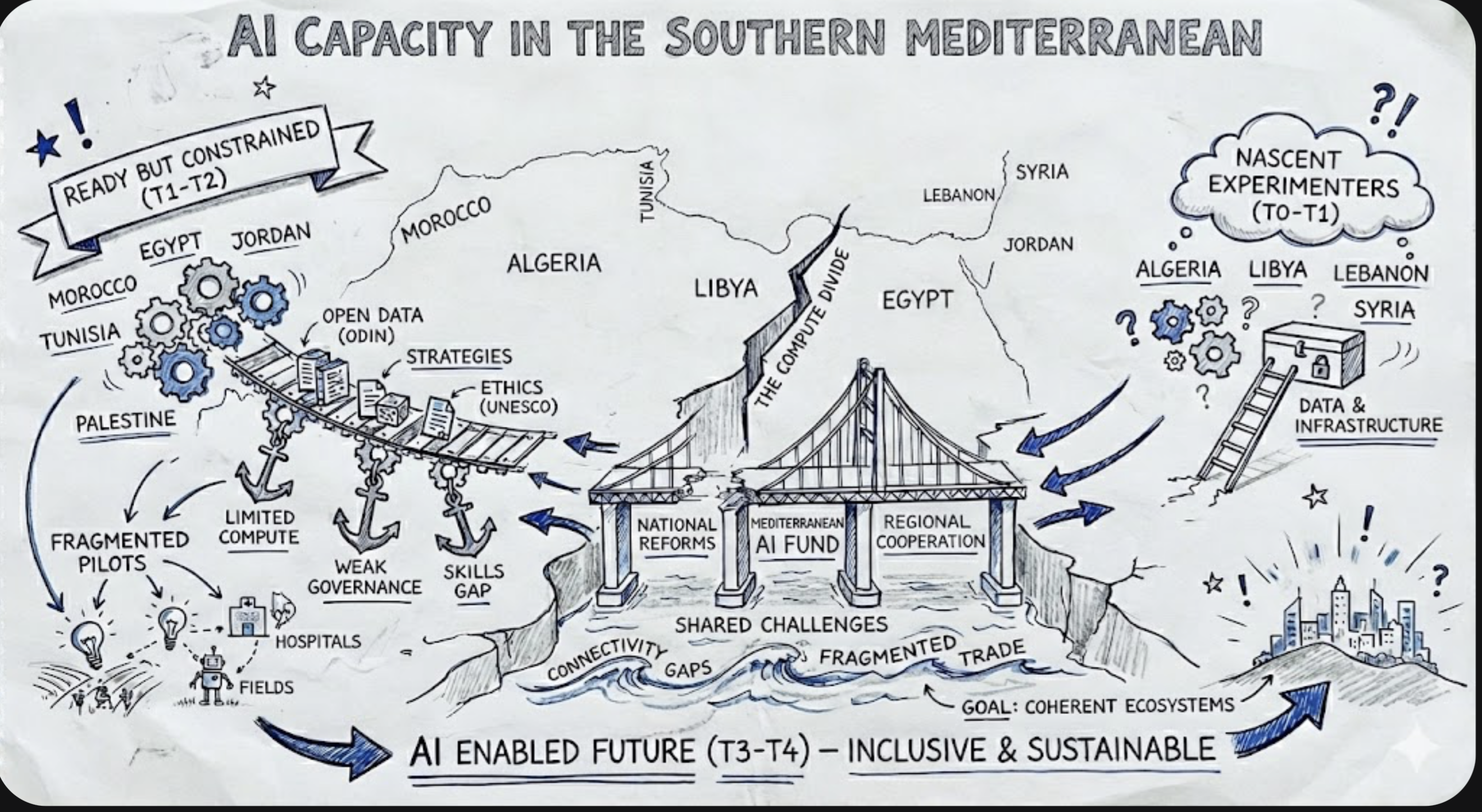
Our comparative assessment reveals wide disparities in AI maturity across the South Mediterranean. Most states remain in Tiers 0–2, reflecting early experimentation, emerging strategies, and limited computing resources. Jordan and Egypt show the strongest progress, while Libya and Syria remain at nascent levels. Morocco benefits from its sovereign computing infrastructure through the TOUBKAL supercomputer, but lacks a fully operational national AI strategy. Table 1 summarizes country placements, readiness scores, and highlights.
Table 1: Classification of AI maturity tiers and highlights (2025).
| Country | AI Maturity Tier | AI Readiness Score (2024) | Highlights |
|---|---|---|---|
| Algeria | T1 – AI experimenters | 39.06 | National AI Council; HPC centre in Oran (groundbreaking March 2025). |
| Egypt | T2 – AI ready | 55.63 | Applied Innovation Center; AI strategy 2025–2030; supercomputing capacity. |
| Jordan | T2 – AI ready | 61.57 | National AI strategy; National AI Ethics Charter (2022); sector pilots in health and education. |
| Lebanon | T1 – AI experimenters | 46.67 | Law 81/2018; university hackathons; early AI strategy (2019). |
| Libya | T0 – AI nascent | 33.25 | National AI policy (2024); initial e-transactions law; small pilots. |
| Morocco | T2 – AI ready | 41.78 | Moroccan International Centre for AI (UNESCO Category II); TOUBKAL supercomputer; Digital Morocco 2030. |
| Syria | T0 – AI nascent | 16.95 | First AI/digital events (2025); early pilots; limited legal frameworks. |
| Tunisia | T1 – AI experimenters | 43.68 | AI task force; data protection law; AI roadmap (2021–2025). |
Source: EuroMedAI (2025), Oxford Insights (2024), national strategy documents.
Beyond these tier placements, several cross-cutting patterns emerge. Countries that have adopted comprehensive national AI strategies or sectoral roadmaps (Egypt, Jordan, Tunisia) generally perform better across the five domains than those that rely on fragmented or draft policy documents. Sovereign compute assets in Morocco and Egypt demonstrate the catalytic effect of infrastructure investment, though they remain underutilized without parallel investments in skills and adoption mechanisms. Smaller states, such as Lebanon, illustrate the difficulty of moving beyond pilot initiatives in the absence of strong institutional anchors or stable governance environments.
The comparison also reveals that progress is uneven not only between countries but also within them. For instance, Egypt has invested in supercomputing and sectoral pilots, yet skills shortages and fragmented data governance continue to slow systemic adoption. Tunisia and Algeria have built legal frameworks around data protection and digital transformation, but their AI ecosystems are still limited in scale and innovation output. This suggests that isolated progress in one domain cannot substitute for a balanced approach across all five domains of the maturity framework.
At a regional level, the findings underscore that while national efforts are beginning to bear fruit, structural bottlenecks such as limited compute capacity, energy reliability, and human capital remain binding constraints. Fragmentation in governance frameworks further prevents the emergence of a coherent regional AI ecosystem. These gaps highlight the urgent need for greater coordination and shared approaches if the South Mediterranean is to avoid deepening its lag behind global leaders in AI.
5. Discussion
The comparative analysis identifies structural constraints facing most South Mediterranean states. Compute capacity remains a major bottleneck: only Egypt and Morocco host sovereign HPC assets, while others depend on limited university or external cloud access. Data governance frameworks are fragmented, with few comprehensive data protection laws implemented effectively. Skills shortages further limit AI deployment, as universities struggle to produce graduates with advanced AI expertise, and brain drain reduces the local workforce. Despite these challenges, sector pilots in agriculture, health, and public administration demonstrate early successes. Egypt’s Applied Innovation Center has deployed AI in health diagnostics, while Jordan’s AI strategy has guided pilots in education and agriculture. Morocco’s supercomputing infrastructure paved the way for Morocco to establish a partnership with UNDP to launch the Digital for Sustainable Development (D4SD) Hub, launched in September 2025 on the sidelines of the 80th UN General Assembly (UNDP, 2025), and strengthen its position as a regional hub for AI research, though scaling from research to adoption remains limited.
Regional cooperation is weak, yet presents one of the most promising solutions. Shared HPC facilities, regional data spaces, and joint research programs could reduce costs and accelerate adoption. Financing remains a critical issue: voluntary financing options outlined in A/79/966 could unlock investments from public, private, and philanthropic sources to address these gaps.
6. Conclusions and Recommendations
The South Mediterranean region occupies a pivotal juncture in its trajectory toward AI development. While several countries have demonstrated nascent or intermediate progress through national strategies, pilot initiatives, and isolated infrastructure investments, the region as a whole risks entrenching structural inequalities if the current AI divide is not addressed decisively. To transform AI from a source of disparity into an enabler of sustainable development, a comprehensive and coordinated policy response is required.
First, national AI strategies must be established, institutionalized, regularly updated, and operationalized through clear mandates, measurable targets, and mechanisms for participatory and inclusive governance. Such strategies should be grounded in human rights principles, and embed local knowledge and culture ensuring that AI deployment enhances social welfare and democratic accountability.
Second, sovereign compute and digital infrastructure need substantial investment, including high-performance computing facilities and data centers, reliable connectivity, and resilient energy systems. Given the high costs involved, regional hubs and shared infrastructure, as well as public-private partnerships represent practical and efficient pathways to achieve scale and reduce duplication.
Third, successful pilot projects in priority sectors such as health, agriculture, education, and public administration should be systematically scaled up into national programs supported by sustainable financing. This requires embedding AI into sectoral development plans, accompanied by robust monitoring and evaluation frameworks.
Fourth, legal and ethical frameworks must be strengthened to address data protection, non-discrimination, privacy, accountability, and algorithmic transparency. Embedding these safeguards into law and practice will help build public trust, mitigate risks, and align regional approaches with global norms.
Fifth, innovative financing mechanisms, such as those outlined in A/79/966, should be mobilized to bridge persistent gaps in infrastructure, skills, and institutional capacity. Blended finance, voluntary contributions, and partnerships with multilateral development banks could provide the resources required for sustained progress.
Finally, regional cooperation should be prioritized in data governance, shared research, and talent development. Joint initiatives can reduce fragmentation, foster knowledge exchange, and promote equitable access to AI technologies, thereby strengthening the region’s collective resilience.
Taken together, these pathways highlight that AI adoption in the South Mediterranean is not merely a technical project but a strategic endeavor intertwined with governance, rights, and sustainable development. By acting collectively and decisively, the region has the opportunity to transform its AI readiness into a foundation for inclusive growth and long-term resilience.
References
Al-Zahrani, A. M., & Alasmari, T. M. (2025). A comprehensive analysis of AI adoption, implementation strategies, and challenges in higher education across the Middle East and North Africa (MENA). Education and Information Technologies. Springer. https://doi.org/10.1007/s10639-024-13300-y
Ali, W., & Khan, A. Z. (2024). Factors influencing readiness for artificial intelligence: a systematic literature review. Data Science and Management, 8, 224–236. https://doi.org/10.1016/j.dsm.2024.09.005
Arab Reform Initiative. (2024). AI in the national AI strategies of the Arab region. Arab Reform Initiative. https://www.arab-reform.net/publication/ai-in-the-national-ai-strategies-of-the-arab-region/
ESCWA. (2025). Artificial intelligence futures for the Arab region. United Nations Economic and Social Commission for Western Asia. https://www.unescwa.org/publications/artificial-intelligence-futures-arab-region
Jobin, A., Ienca, M., & Vayena, E. (2019). The global landscape of AI ethics guidelines. Nature Machine Intelligence, 1(9), 389–399. https://doi.org/10.1038/s42256-019-0088-2
OECD. (2024). Artificial intelligence review of Egypt. Paris: OECD Publishing. https://www.oecd.org/publications/artificial-intelligence-review-of-egypt-3c437131-en.htm
Oxford Insights. (2024). Government AI readiness index 2024. Oxford Insights. https://www.oxfordinsights.com/government-ai-readiness-index
Salem, F. (2024). The state of AI and data governance in the Arab region: Challenges and future policy directions. ESCWA & Mohammed Bin Rashid School of Government. https://www.unescwa.org/sites/default/files/event/materials/14-MBRSG-ESCWA-FS-en.pdf
Trigui, H., et al. (2024). Exploring AI governance in the Middle East and North Africa (MENA) region: Gaps, efforts, and initiatives. Data & Policy, 6, e27. Cambridge University Press. https://doi.org/10.1017/dap.2024.27
UNESCO. (2023). Strengthening AI governance: UNESCO pilots its capacity building framework for digital transformation. UNESCO. https://www.unesco.org/en/articles/strengthening-ai-governance-unesco-pilots-its-capacity-building-framework-digital-transformation
United Nations. (2024). Global digital compact: Overview and adoption at the Summit of the Future. New York: Office of the Secretary-General’s Envoy on Technology. https://www.un.org/techenvoy/global-digital-compact
United Nations. (2025). Innovative voluntary financing options for artificial intelligence capacity-building (A/79/966). New York: United Nations. https://documents.un.org/doc/undoc/gen/N25/207/73/pdf/N2520773.pdf
Tortoise Media. (2024). The Global Artificial Intelligence Index 2024. Tortoise Media. https://www.tortoisemedia.com/2024/09/18/the-global-artificial-intelligence-index-2024
UNDP. (2025). In partnership with UNDP, the Kingdom of Morocco launches a new facility to help accelerate digital transformation in the Arab States region and Africa. United Nations Development Programme. https://www.undp.org/arab-states/press-releases/partnership-undp-kingdom-morocco-launches-new-facility-help-accelerate-digital-transformation-arab-states-region-and
Historique des mises à jour
Initial publication
Dernière mise à jour