Digital Humanism Fellowship 2026–2027: Applications Now Open
The Institute for Human Sciences (IWM) is offering three-month Junior Visiting Fellowships in Vienna for doctoral and recent postdoctoral researchers across all academic disciplines. Applications close on 21 September 2026.
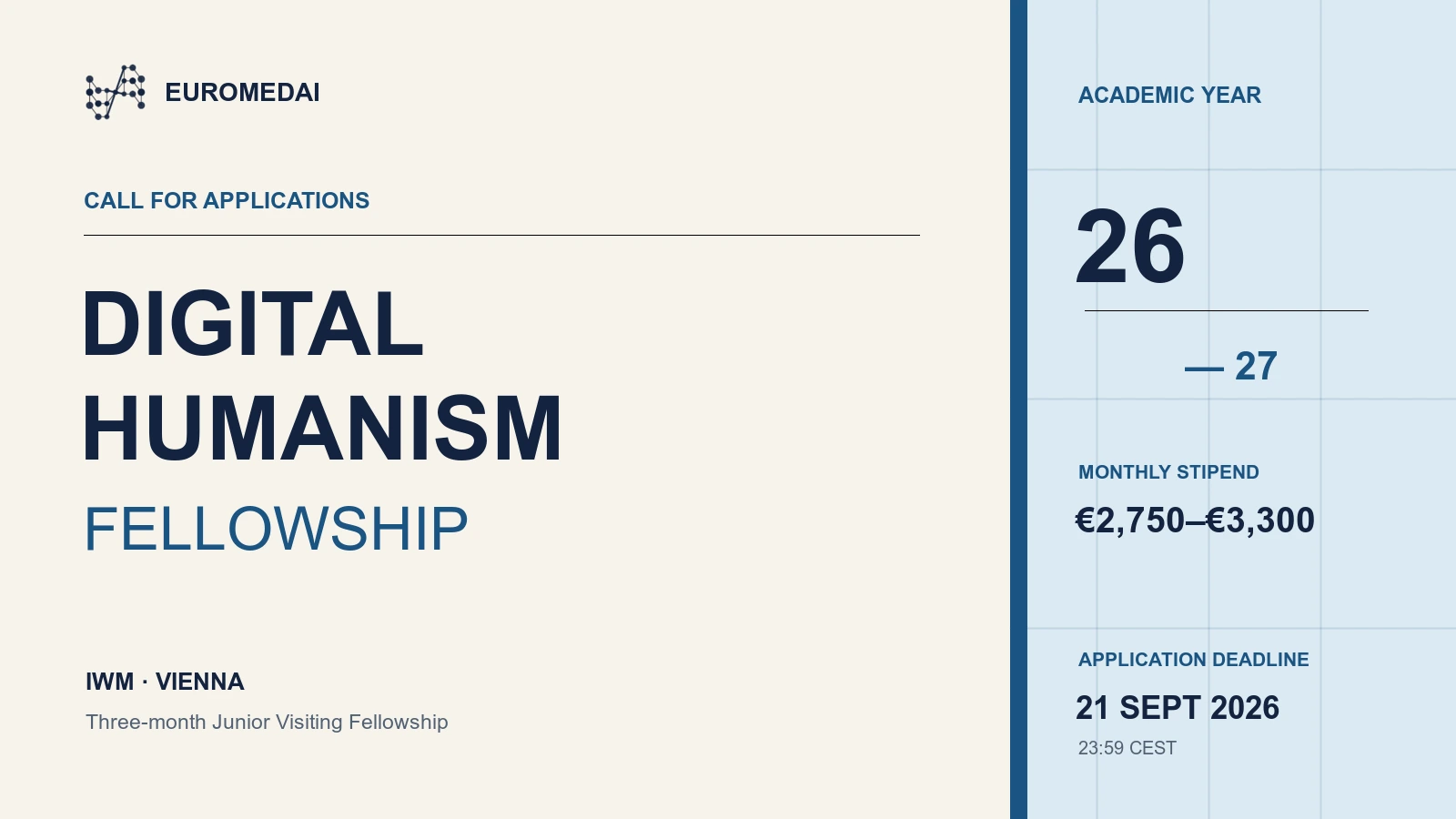
Applications are open for the Digital Humanism Fellowship 2026–2027 — formally a Junior Visiting Fellowship — at the Institute for Human Sciences (IWM) in Vienna. The fellowship welcomes doctoral researchers and recent postdoctoral scholars from all academic disciplines whose work examines how digitalization intersects with society, economics, politics, geopolitics and human values.
This is a funded, in-person visiting fellowship in Vienna: a monthly stipend, a desk at IWM Vienna and three months free of teaching and administration. It suits a PhD candidate finishing a dissertation chapter as readily as a recent postdoc turning a thesis into a book or building an AI ethics or AI governance research agenda.
Selected fellows will spend three consecutive months at the IWM between February and June 2027. The application deadline is 21 September 2026 at 23:59 CEST.
For researchers across the Mediterranean working on AI governance, democracy, inequality, social justice, digital rights or the geopolitical consequences of technology, this is a particularly relevant international opportunity. The call has no geographic restriction: Mediterranean applicants are eligible on the same terms as applicants from other regions.
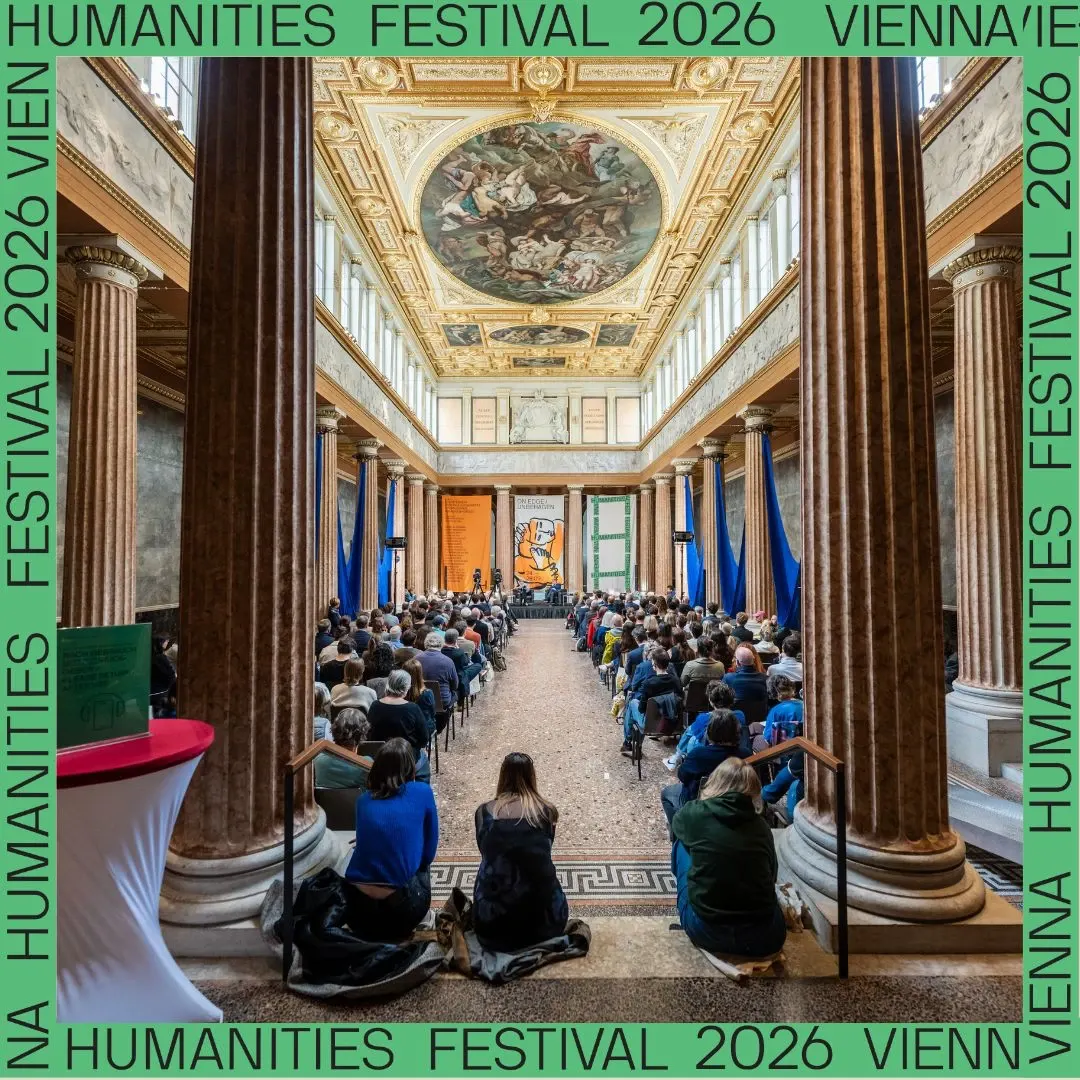
Fellowships at the IWM are lived in public: fellows present work in colloquia, lectures and festival programming alongside the wider Viennese research community. Image: IWM Humanities Festival 2026.
What Digital Humanism Means
Digital Humanism studies — and seeks to influence — the relationship between technology and humankind. Its purpose is not only to describe the digital transformation, but to help shape it in ways that support a better society and fully respect universal human rights.
The IWM’s program was launched in 2022 and is run in close collaboration with TU Wien and the wider Digital Humanism community in the city. Its activities are inspired by the Vienna Manifesto on Digital Humanism.
The fellowship therefore welcomes interdisciplinary projects connecting fields such as computer science, the humanities and the social sciences. Relevant questions may concern democracy and governance, inequality and social justice, the opportunities created by digital transformation, or its societal, economic and geopolitical consequences.
Digital Humanism is not Digital Humanities
IWM explicitly distinguishes this research area from projects that simply use digital tools or new technologies to conduct humanities research. Applications must investigate the broader human, social, political, economic or geopolitical dimensions of digitalization.
What the Digital Humanism Fellowship Pays and Provides
Doctoral candidates
€2,750
per month for three months
Postdoctoral fellows
€3,300
per month for three months
IWM also provides fellows with office space, internet access, in-house research facilities and administrative services at no charge. Fellows join the institute’s scholarly community and are invited to participate in its activities. The selected junior fellows’ research terms will overlap with the presence of the Senior Digital Humanism Visiting Fellow.
The stipend is intended to cover all expenses associated with the fellowship, including travel to and from Vienna, accommodation, health insurance, utilities, local transport, telecommunications and research costs. These expenses are not reimbursed separately.
How the Digital Humanism Fellowship Could Help Your Career
A three-month residency is short. What makes it worth the application effort is what it puts on your record and in your network:
- Three months of protected writing time. No teaching load, no committee work, no grant administration — the stipend exists so that the fellowship term is spent on the project you proposed.
- An institutional affiliation you can cite. “Junior Visiting Fellow, Institute for Human Sciences (IWM), Vienna” is a line that international review panels recognize, and it signals that your project passed a competitive, peer-reviewed international selection.
- A live audience for work in progress. The Fellows’ Colloquium puts your project in front of computer scientists, philosophers, historians, lawyers and social scientists in the same room — the kind of cross-disciplinary stress test that is hard to arrange at a single home department.
- A concrete route to publication. The program has a track record of turning fellowship research into books and into the open-access proceedings of its research conference, rather than leaving it as an unpublished residency report.
- Public visibility beyond academia. The Digital Humanism Fellowship Lecture series and IWM’s public events put fellowship research in front of policymakers, journalists and the Viennese public.
- A European research base. For Mediterranean and North African researchers in particular, a funded stay at IWM Vienna is a practical entry point into European research networks, TU Wien’s Digital Humanism community and future collaborations or consortium bids.
- Overlap with a senior scholar in your field. Junior fellowship terms are synchronized with the Senior Digital Humanism Visiting Fellow’s residency, so each cohort has a senior interlocutor on site.
- An alumni network that keeps working. IWM fellows stay connected to the institute long after the term ends, which matters more for early-career researchers than the three months alone.
One honest caveat: the stipend is a flat amount meant to absorb travel, Vienna rent, health insurance and research costs, and nothing is reimbursed on top of it. Budget the three months before you commit.
What Past Digital Humanism Fellows Have Done
The clearest way to judge a fellowship is by what comes out of it. Since 2022, the Digital Humanism program has produced books, an open-access conference volume, a public lecture series and a fellowship cohort drawn from Europe, Africa, Asia, Australia and the Americas.
Books published out of the program
| Book | Author | Publisher | Year |
|---|---|---|---|
| Co-Evolution: Die Symbiose von Mensch und Maschine | Edward Lee (UC Berkeley) | mandelbaum verlag | 2023 |
| Digital Humanism | Ludger Hagedorn (IWM, program lead) | Springer Cham | 2025 |
| Jenseits der Genies: Geschichten aus der IT-Arbeit | Thomas Haigh (University of Wisconsin–Milwaukee) | mandelbaum verlag | 2025 |
Thomas Haigh’s book is a direct product of a visiting fellowship: IWM notes that it was written within the Digital Humanism program and published in German translation (by Andreas Wirthensohn) in October 2025.
Conferences and lectures fellows take part in
- Digital Humanism: First Interdisciplinary Science and Research Conference — held at the IWM on 20–21 November 2025, with open-access proceedings published in November 2025.
- IWM Digital Humanism Fellowship Lecture — the program’s flagship public lecture. The March 2026 edition, The AI Race: Boom or Doom?, was delivered by Toby Walsh (UNSW Sydney), who held a Digital Humanism fellowship on Trustworthy AI and Digital Humanism in March 2026.
- Book talks and seminars — for example Six Essential Ideas About AI with Toby Walsh (25 March 2026) and Beyond Hype and Fear: Responsible AI for Societal Transformation (8 September 2025).
- Fellows’ Colloquium — the internal work-in-progress format where fellows present their project to the institute, such as Hans Akkermans’s Innovation as Technosociality: Myth, Magic, and How Innovation Really Works (29 April 2025).
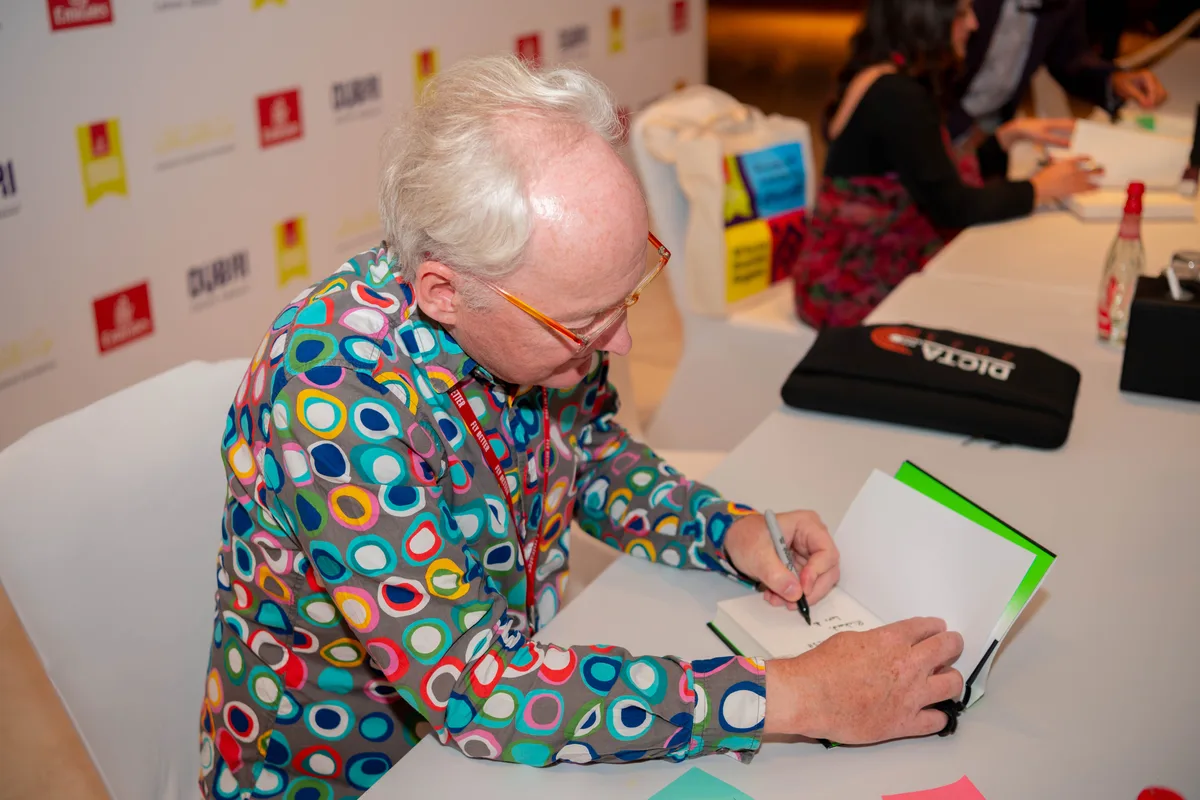
Toby Walsh (UNSW Sydney), who held a Digital Humanism fellowship at the IWM in March 2026 and delivered the fellowship lecture The AI Race: Boom or Doom?, signing copies of his book at a public festival. Photo: Serine Ghabri,
CC BY-SA 4.0
, via Wikimedia Commons.
The kind of projects that get selected
Recent Digital Humanism fellowship projects give a concrete sense of the range and the level:
- Saniya Irfan (IIT Delhi) — Scripts That Don’t Fit: The Hidden Bias of NLP in South Asian Languages
- Faridah Muli (University of Nairobi) — Digital Surveillance and the Human Rights Costs of Countering Violent Extremism: Gender, Youth, and Affected Communities in Kenya
- Wanqiang Wu (Sun Yat-sen University, Guangzhou) — Algorithmic Justice: AI-Assisted Judicial Decision-Making in Comparative Perspective
- Matteo Nebbiai (King’s College London) — The EU in a Weaponized Digital World: A Network Analysis
- Magdalena Morze (Łukasiewicz Research Network, Poznań) — Trust Landscapes in Human–Robot Interaction: Industrial vs. Social Robots
- Carlo Ghezzi (Politecnico di Milano) — Rethinking the Role of Universities in the Light of Digital Humanism
- Magdalena Krysztoforska (ICI Berlin) — World Models and the AI Perspective
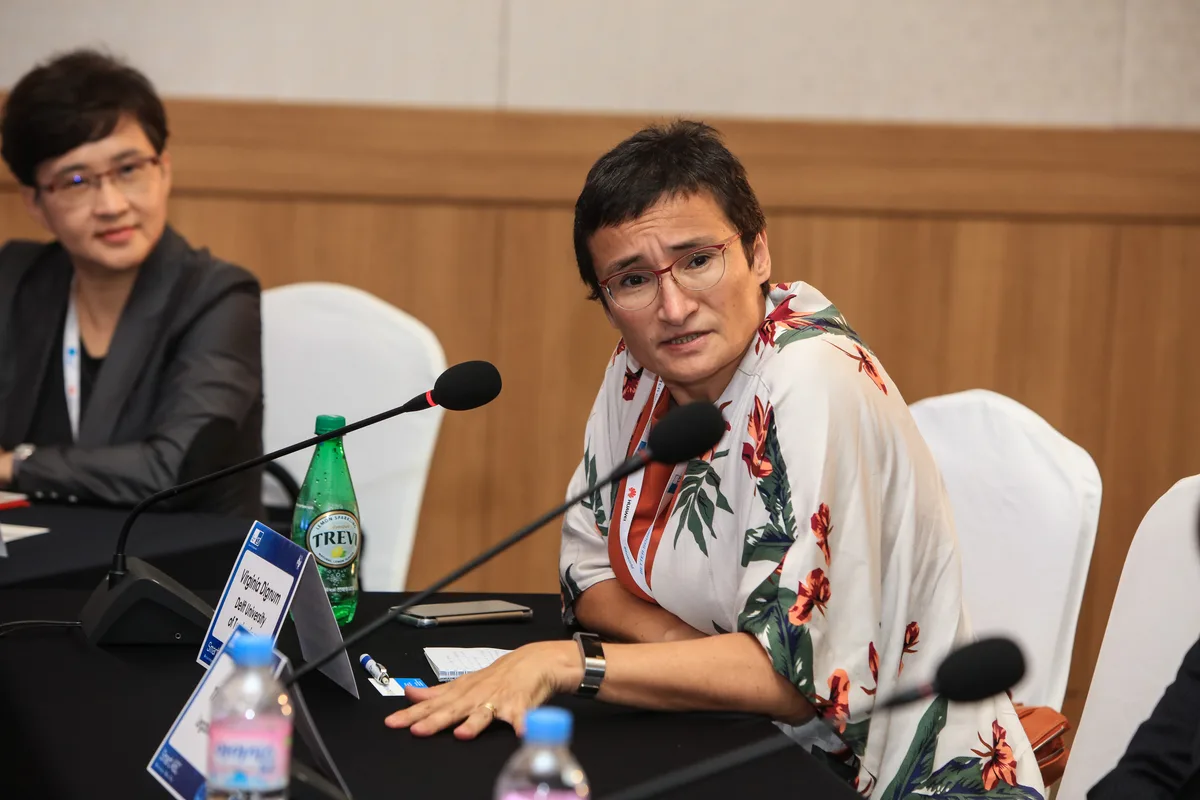
Virginia Dignum (Umeå University), listed among the IWM’s Digital Humanism fellows, speaking at an international AI policy round table. Photo: ITU Pictures,
CC BY 2.0
, via Wikimedia Commons.
Fellows have come from institutions including Middlebury College, UC Berkeley, TU Wien, King’s College London, Brown University, RMIT, LMU Munich, Northeastern University, the University of Coimbra, the University of Turin, the Polytechnic University of Milan, the University of the Witwatersrand, Daystar University in Nairobi, the Indian Institute of Technology Delhi and the University of Macau. The cohort is genuinely international, and researchers from outside Western Europe and North America are well represented — a useful signal for Mediterranean applicants weighing their chances.
Who Can Apply for the Digital Humanism Fellowship
Applicants must meet one of the following conditions by the application deadline:
- Be enrolled in a doctoral program; or
- Hold a PhD awarded no earlier than 21 September 2022.
The call is open to all academic disciplines and does not specify a nationality or country-of-residence restriction. Researchers based in — or working on issues relevant to — Mediterranean countries are therefore eligible if they meet the academic requirements.
Additional restrictions apply:
- A candidate may not submit multiple IWM fellowship applications in the same academic year.
- Previous IWM fellows must wait three academic years before applying for another fellowship.
Call for applications · open now
Three months in Vienna to research technology and society
Open to current doctoral candidates and scholars who completed their PhD no earlier than 21 September 2022. Monthly stipends are €2,750 for doctoral candidates and €3,300 for postdoctoral fellows. Deadline: 21 September 2026, 23:59 CEST.
Research Areas the Program Prioritizes
From 2026, the program’s calls invite projects related to three issues in particular: democracy and governance, inequality and social justice, and the opportunities and potential of digital transformation. Strong proposals will connect digitalization to questions such as:
- Democracy and governance — including the effects of algorithms, platforms and AI on institutions, participation and public life.
- Inequality and social justice — including access, exclusion, discrimination, labor and the distribution of technological power.
- Human rights and human values — including how technological development can be aligned with rights, dignity and social well-being.
- Societal, economic and geopolitical change — including the regional and international consequences of digital transformation.
- Opportunities created by digital transformation — including constructive approaches to innovation and better social outcomes.
These themes make the call relevant to work across the Euro-Mediterranean space, but applicants should frame their projects around the fellowship’s scholarly criteria rather than geography alone.
If this call does not fit your stage or your timing, it is not the only door into the field: see our guide to Digital Humanism opportunities, covering summer schools, the research conference and the free lecture series.
What the Application Must Include
All materials must be submitted in English through IWM’s online application form. Applications sent by email will not be considered.
- A brief motivation letter explaining how time at IWM would benefit the project, how the research connects to IWM’s mission and work, and the applicant’s concrete research and writing goals during the fellowship.
- A short project description of no more than 550 characters, including spaces.
- A project proposal of no more than 7,500 characters, including spaces, covering:
- the project’s objectives;
- the current state of research;
- the methods; and
- a work plan.
- A curriculum vitae, including a list of publications.
- Two academic recommendation letters from scholars familiar with the applicant’s work.
Two submission details can make an otherwise strong application ineligible
Combine every attached document into one PDF; the application form accepts only one attachment.
Use Latin characters only in the attachment’s filename.
Recommendation letters are submitted directly by the recommenders. They receive an automated link only after the applicant submits the application, and both letters must arrive before the deadline. Applicants should therefore submit early enough to give their recommenders time to respond.
Digital Humanism Fellowship Deadline and Selection Timeline
| Stage | Date |
|---|---|
| Application deadline | 21 September 2026 · 23:59 CEST |
| Applicants notified by email | By 30 November 2026 |
| Three-month fellowship term | Between February and June 2027 |
Each fellowship begins on the first day of its first month and ends on the last day of its third month. The Digital Humanism Fellowship application deadline is firm: late submissions and applications sent by email are not considered.
How to Apply for the Digital Humanism Fellowship 2026–2027
Read the complete eligibility and submission instructions on the official Digital Humanism Fellowship call, then use the application button on that page to access IWM’s online form. The deadline is 21 September 2026 at 23:59 CEST.
Because the proposal and project-summary limits count spaces as characters, prepare both texts in a tool that provides an exact character count. Submit the application several days before the deadline so the two recommenders can upload their letters on time.
About the IWM and Its Digital Humanism Program
The fellowship forms part of IWM’s Digital Humanism Program. IWM is an independent institute for advanced study in the humanities and social sciences in Vienna, based at Spittelauer Lände 3 in the ninth district, a short walk from the Danube Canal. The fellowship is funded by the Federal Ministry of Innovation, Mobility and Infrastructure of the Republic of Austria, with the program also supported by the Polish Ministry of Science and Higher Education, which signed a funding agreement with the IWM in July 2026 covering 2026–2027.
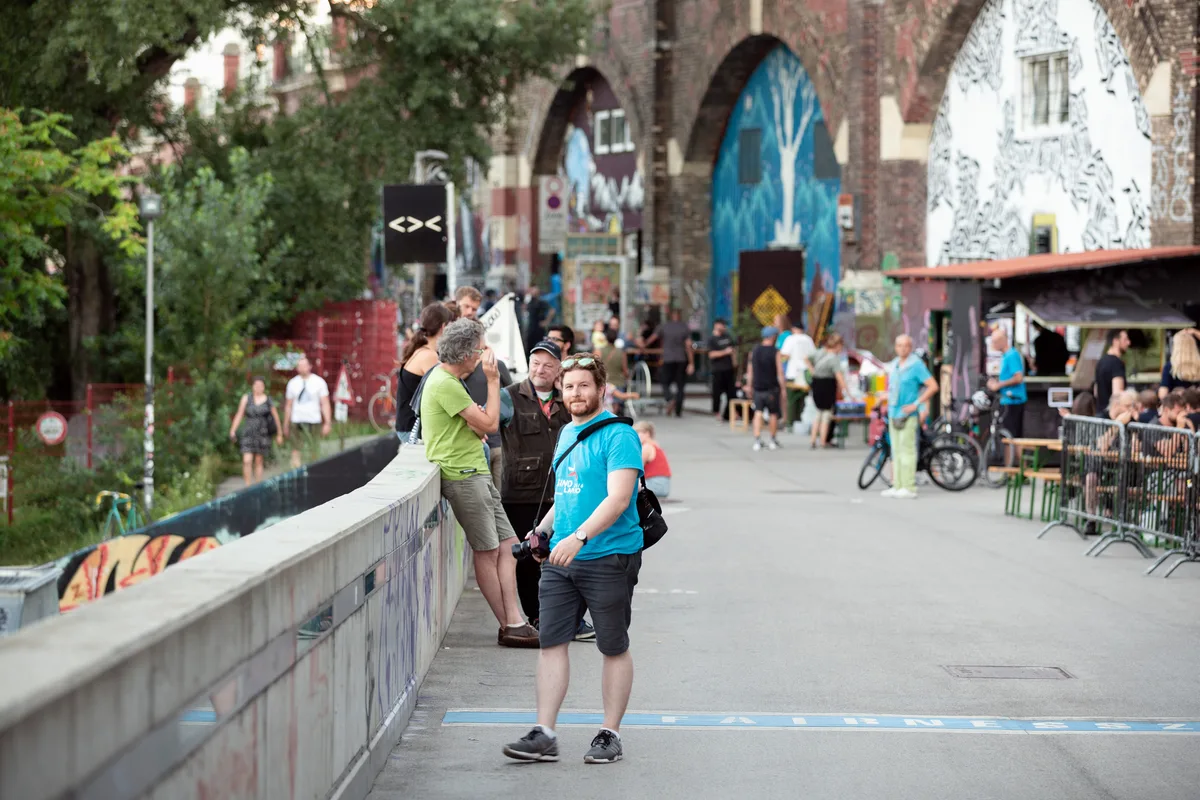
The Spittelauer Lände in Vienna’s ninth district, the street where the IWM is based. Photo: Manfred Werner (Tsui),
CC BY-SA 4.0
, via Wikimedia Commons.
EuroMedAI opportunities
Researching technology in its human context
EuroMedAI connects researchers, civil-society actors and technologists across the Mediterranean working on AI, human rights and democratic governance. Join the network to follow future calls, collaborations and research opportunities.
Cover image: Vienna at dusk, photo by Pierre Blaché (CC0, via Wikimedia Commons). Fellowship details in this article are drawn from the IWM’s official call and Digital Humanism program pages.
Frequently asked questions
- What is the Digital Humanism Fellowship?
- The Digital Humanism Fellowship is a Junior Visiting Fellowship at the Institute for Human Sciences (IWM) in Vienna. It funds three consecutive months of residential research on how digitalization intersects with society, politics, economics and human values, and is open to researchers from all academic disciplines.
- What is the Digital Humanism Fellowship 2026–2027 deadline?
- Applications close on 21 September 2026 at 23:59 CEST. Applicants are notified by email by 30 November 2026, and the three-month fellowship term takes place between February and June 2027.
- How much does the IWM Digital Humanism Fellowship pay?
- Doctoral candidates receive a stipend of €2,750 per month and postdoctoral fellows receive €3,300 per month, for three months. IWM adds office space, internet access, in-house research facilities and administrative services at no charge. The stipend is intended to cover travel, accommodation, health insurance and all other fellowship costs, which are not reimbursed separately.
- Who is eligible for the Digital Humanism Fellowship?
- You must either be enrolled in a doctoral program or hold a PhD awarded no earlier than 21 September 2022. The call is open to all academic disciplines and sets no nationality or country-of-residence restriction. You may not hold more than one IWM fellowship application in the same academic year, and former IWM fellows must wait three academic years before reapplying.
- Can researchers from Mediterranean and North African countries apply?
- Yes. The call has no geographic restriction, so researchers based in Morocco, Algeria, Tunisia, Egypt, Lebanon, Jordan, Türkiye and other Mediterranean countries are eligible on the same terms as applicants from anywhere else, provided they meet the academic requirements. Recent IWM Digital Humanism fellows have come from institutions in Nairobi, Delhi, Guangzhou, Johannesburg and Coimbra as well as Western Europe and North America.
- Is Digital Humanism the same as Digital Humanities?
- No. Digital Humanities uses digital tools and methods to conduct humanities research. Digital Humanism studies the relationship between technology and humankind and seeks to shape digitalization so that it supports a better society and respects universal human rights. IWM explicitly excludes projects that only apply digital tools to humanities questions.
- Is the Digital Humanism Fellowship remote or in person?
- It is in person. Selected fellows spend three consecutive months in residence at the IWM in Vienna, joining the institute's scholarly community, its fellows' colloquia and its public events. Each term begins on the first day of its first month and ends on the last day of its third month.
- What documents does the Digital Humanism Fellowship application require?
- A motivation letter, a project description of no more than 550 characters including spaces, a project proposal of no more than 7,500 characters including spaces, a CV with a list of publications, and two academic recommendation letters. Everything must be in English, combined into a single PDF with a Latin-character filename, and submitted through IWM's online form.
Share